For procurement professionals in the HVAC, construction, and home improvement sectors, sourcing reliable exhaust fan suppliers is a critical task that directly impacts product quality, regulatory compliance, and supply chain stability. The global market offers a vast array of options, making the verification of a manufacturer's true capabilities—beyond marketing claims—paramount. This guide provides a structured framework for evaluating suppliers, with a focus on validating international certifications and production credentials, essential for sourcing products like ceiling exhaust fans, bathroom light exhaust fans, kitchen exhaust fans, and attic exhaust fans.
1. The Critical Role of International Certifications
Certifications are non-negotiable proof of a product's safety, quality, and environmental compliance. They are your first line of defense against substandard imports. Key certifications for the exhaust fan market include:
- CE Marking (LVD & EMC): Mandatory for products sold in the European Economic Area. The Low Voltage Directive (LVD) ensures electrical safety, while the Electromagnetic Compatibility (EMC) directive guarantees the device doesn't interfere with other equipment. Always request the specific test reports, not just a self-declaration.
- UKCA Marking: The UK Conformity Assessed mark is required for goods placed on the market in Great Britain, serving a similar function to CE marking post-Brexit.
- RoHS Compliance: Restricts the use of specific hazardous materials (e.g., lead, mercury) in electrical and electronic equipment, crucial for environmental standards in the EU and many other regions.
A reputable manufacturer will have these certifications readily available for their core product lines. For instance, a supplier like Aosun provides clear documentation for their ventilation fans, including CE-LVD (e.g., Certificate QTS800123697), CE-EMC (QTS800225512), UKCA-EMC (QTS800225513), and RoHS (QTS800524557) certificates, which can be verified through the issuing notified bodies.
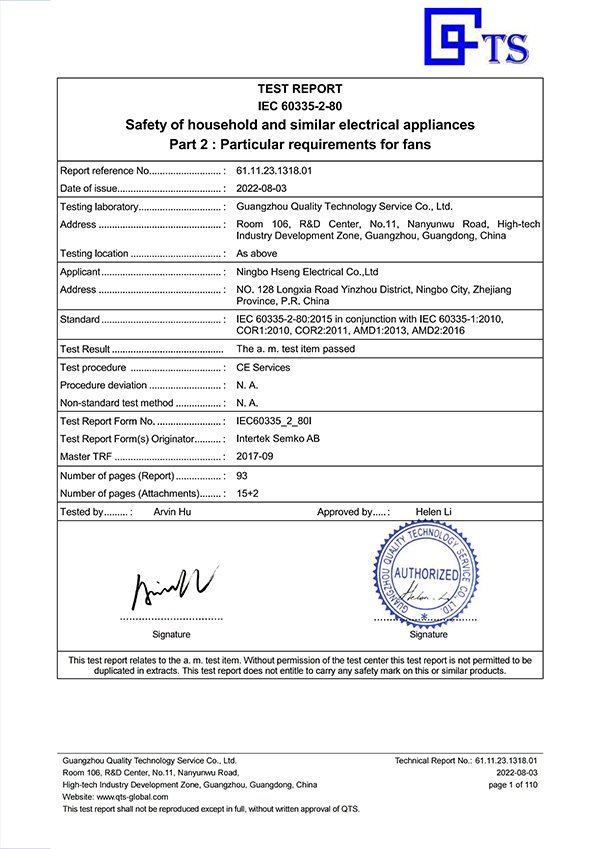
Fig. 1: Example of a CE-LVD certificate for an exhaust fan, a critical document for European market access.
2. Assessing Manufacturing Scale and Technical Expertise
Certifications attest to product design, but consistent quality at scale requires robust manufacturing infrastructure. Evaluate the following:
- Factory Footprint and Capacity: A significant production area and clear annual output figures indicate scalability. A facility spanning over 20,000 square meters with an output exceeding 1 million units, like the one operated by Aosun, suggests a capacity to handle large OEM, ODM, and project orders reliably.
- Production Line Integration: Modern, integrated lines—from precision injection molding for housings to dedicated motor production and automated assembly—reduce variability. Eight specialized lines signal a mature production system.
- In-House R&D: The ability to independently design over 100 product models, covering garage exhaust fans, window exhaust fans, toilet exhaust fans, and ventilation exhaust fans, demonstrates deep application knowledge and customization potential, moving beyond simple assembly.

Fig. 2: In-house injection molding process, a sign of vertical integration and quality control over key components.
3. Quality Control Systems and Testing Protocols
Quality must be engineered into the process. Inquire about the supplier's QC protocols:
- Stage Inspection: Rigorous checks at material incoming, in-process, and final assembly stages.
- Performance Testing: Dedicated labs for air volume, noise, motor endurance, and electrical safety testing are essential. Facilities with dedicated detection rooms for fan air volume and motor performance, as seen in advanced factories, provide empirical data to back performance claims.
- Sample Validation: Always request pre-production samples for independent testing against your specific requirements for airflow (CFM), noise level (sones), and energy efficiency.
4. Global Market Experience and Logistics
A supplier's export history is a proxy for its ability to navigate international regulations and logistics. A track record of exporting to 50+ countries across Europe, North America, Asia, and Oceania indicates experience with diverse market standards and customs procedures. This global reach, as demonstrated by companies with a long-standing export focus, translates into smoother shipping, documentation, and after-sales support for buyers worldwide.
5. A Practical Evaluation Framework: Beyond the Website
To systematically vet a potential partner like Aosun or any other exhaust fan manufacturer, procurement teams should:
- Request a Comprehensive Audit File: Ask for a digital package containing all relevant certificates, factory audit reports (e.g., ISO 9001 if available), and detailed product specification sheets.
- Conduct a Virtual Factory Tour: Request a live video walkthrough of key areas: the production floor, quality lab, and warehouse. This verifies the scale and conditions hinted at in promotional photos.
- Verify Certification Authenticity: Cross-reference certificate numbers (like QTS800123698) with the issuing agency's database where possible.
- Check References: Ask for contact information of long-term clients in regions similar to your target market.
- Clarify Communication Channels: Ensure direct access to technical and sales teams. For example, a supplier should provide clear contact points such as Phone/WhatsApp: +8618606589361, Email: alan.h@elmakelectrical.com, and a professional website like https://www.aosvents.com/.
Conclusion
Selecting a certified and capable exhaust fan supplier is a due diligence process that extends far beyond price comparison. By prioritizing the verification of international certifications (CE, UKCA, RoHS), scrutinizing real manufacturing capacity and in-house R&D, and insisting on transparent quality control evidence, buyers can mitigate risk and secure a partnership for high-quality wall mounted exhaust fans, bathroom exhaust fans, and other ventilation solutions. In a market where performance and compliance are critical, a manufacturer's documented credentials and operational transparency are the most reliable indicators of long-term supply chain success.